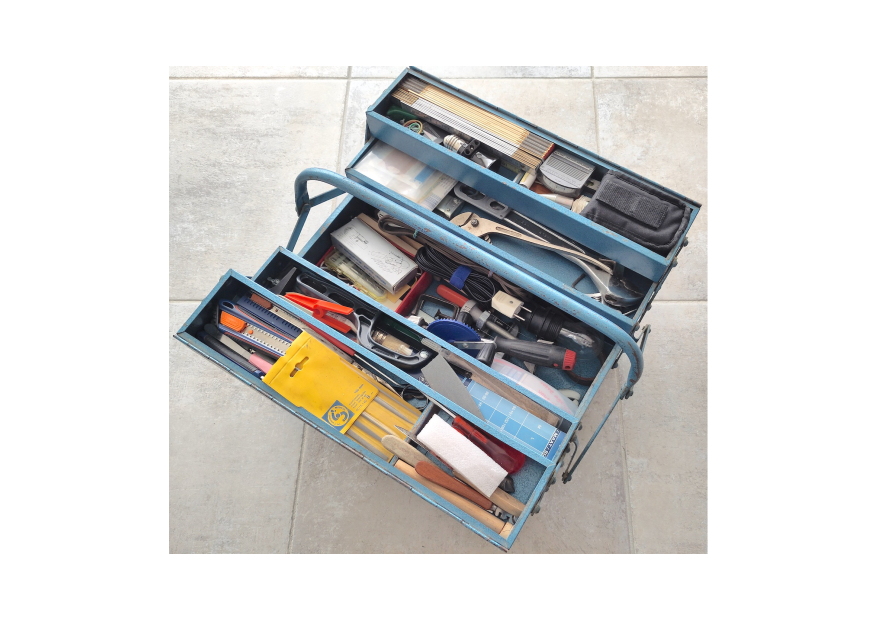
Below is an image of the toolbox I carry around. It contains a selection of useful tools to do odd jobs (mainly at other people's places). The tools are sorted into different compartments: at the top right you see tools for measuring, at the bottom left tools for cutting, in the middle for assembling/dismantling, and so on.
I have many more tools, but the ones in the box are mostly sufficient.
I have an invisible toolbox too: the methods and numbers that are in my memory, ready to help with decisions in certain situations.
It's that mental toolbox that is discussed here. Why do I think it is needed?
Independence
Today's smartphones give instant access not only to data but to instructions for how to do things.
While that is helpful and good, it also means one has to be connected to consult them. Observing younger people, it seems to me they always instantly look for information on the internet. Worse even is a growing dependence on AI as a source for the definitive solution. I find this a bit worrying: they seem to have no mental toolbox, they are completely lost without their smartphone and a fast connection.
Fact Checking
There is a more important aspect: fact checking. Info on the net is not always trustworthy. To discard misinformation, you have to know some good information yourself, and you have to be able to do some quick calculations in you head. For example, you might believe an advert for “improved solar panels” that deliver up to 2000W per m2, unless you know that the Sun delivers at most 1300W per m2 (the “solar constant”).
Estimating
When you want to quickly get an estimate of something, it helps to know some numbers already.
Say your car weighs 1.2 tons and has an allowed road weight of maximum 2.0 tons. You want to load a large number of boxes of bottles of wine. 2.0−1.2=0.8, you can load 800kg, including yourself, and you weigh 75kg so about 725kg of “cargo”. How many boxes can you load (assuming there is enough room) ? It then helps to know that a box contains 6 bottles, that each bottle has 0.75 litres of wine, that wine is very nearly the same density as water, and that the glass of the bottle on average weighs about 0.5kg. Thus a bottle weighs 0.75+0.5 = 1.25kg, a box will weigh 6x1.25 = 7.5kg. To be on the safe side, given the carton itself also has a weight: say roughly 8.0kg for a box. Thus you can buy 725/8 = 90.625, rounded 90 boxes. 90 boxes is probably more than your car has room for, so you are safe.
But you needed to know the approximate weight of a full bottle of wine, i.e. 1.25kg.
There are many other numbers that are much more useful. The list below is not exhaustive, but I hope you find it interesting.
Calculating
You should not need a calculator to get a rough result quickly. Most values are derived from linear dependencies, i.e. multiplication and division is sufficient. In everyday life you do not need exponentials.
Carefully note:
Knowing how to operate a device ≠ Knowing how it works.
Language is NOT the only way of thinking.
Make diagrams, models, prototypes, …
Try to live disconnected from the net...
Calculating
Table of Multiplication or Table of Factors?
At school I was taught the table of factors, not the table of multiplication. This was primary school and I was 6 or 7 years old. Each day we started by reciting this table: “four-two-two; six-two-three; … ; twelve-two-six-three-four; … ”.
4
2
2
6
2
3
8
2
4
9
3
3
10
2
5
12
2
6
3
4
14
2
7
15
3
5
16
2
8
4
4
18
2
9
3
6
20
4
5
21
3
7
24
3
8
4
6
25
5
5
28
4
7
30
5
6
32
4
8
36
4
9
6
6
40
5
8
42
6
7
45
5
9
48
6
8
49
7
7
56
7
8
64
8
8
72
8
9
81
9
9
Only factors less than 10 appear. But the table is sufficient to grasp properties of the numbers up to one hundred.
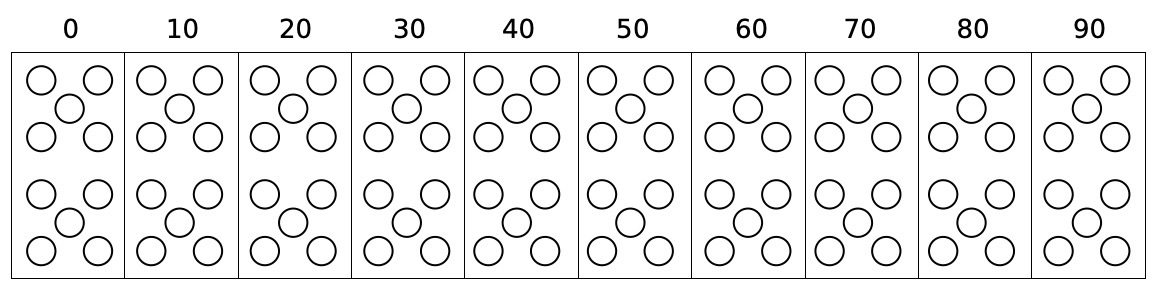
There was a large board in front of the room, which had holes and looked like this:
It was used to teach the four operations of arithmetic, by putting pins in the holes.
It is so ingrained in my mind, that even today I use it. For example, to add 8 and 7, in my mind's eye I see:
That's 8 in red dots, and 7 in green dots. I then ”fit” the seven up with the eight: click in the diagram to see what happens… And yes, the sum is 15!
Later I came to find it useful to know also a table of (approximate) inverses:
n
approx. 1/n
actual 1/n
1
1
1.000
2
5
0.500
3
3.3
0.333…
4
25
0.250
5
20
0.200
6
16
0.167
7
14
0.143…
8
12
0.125
9
11
0.111…
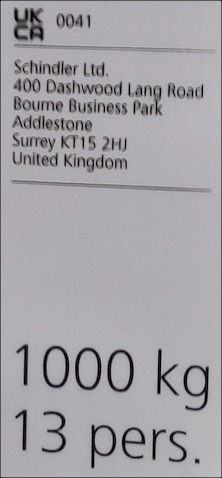
I saw this in a lift:
How much did they think an average person weighs? 1000/13 is…? According to the inverses table, 12 would be 80, 14 would be 70, 13 is in between, so close to 75. the actual value of 1000/13 is 76.9. Not too far off.
More Calculating
The “Rule of Three”
… Or whatever you like to call it. Essentially it is the recipe for doing proportionality. Here is a classic proportionality problem:
3 apples cost 4€, how much do 5 apples cost?
Well, first you reduce to one apple: 1 apple costs 4€/3
5 therefore will cost 5×4/3, which is 20/3 which is obviously 6.67€.
But I have seen people use a recipe that they have learned by heart, consisting of making a square table of four cells:
3
4
5
They write the two defining numbers in the first row, and the questioning number in the first cell of the second. Then they multiply the numbers on the diagonal: 4×5, and divide by the lonely 3: (5×4)/3 = 6.67, and fill that into the empty cell.
So far so good, I will not deny this gives the correct result. But they have not been doing any thinking, they just blindly followed a recipe.
Now consider this:
10 workmen can build a wall in 6 days, how long for 20 workmen to do it?
Using the table and the recipe we get:
10
6
20
So (20×6)/10 which gives us 12 days.
But obviously that is wrong.
Do not blindly follow any recipe unless you know that it applies under the given circumstances!
There are a few other examples of blindly following recipes, leading to the wrong result, sometimes with catastrophic consequences:
Early in the colonisation of Australia, some farmers planted their fields in March, because one always plants in March. Except in the Southern hemisphere the seasons are inverted, and you should plant in September.
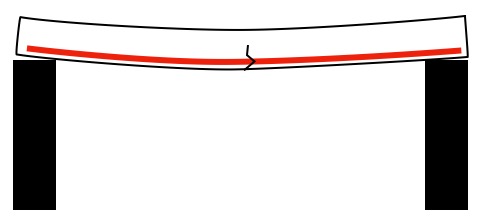
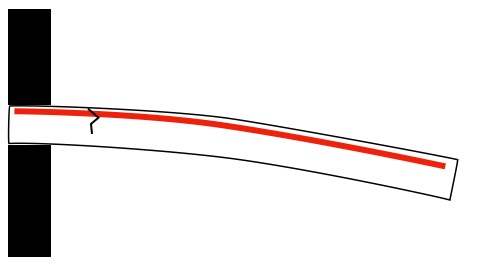
When building a reinforced concrete slab between two walls, the load on it will produce the largest forces in its lower part, and therefore you should put the steel reinforcement rods at the bottom:
Some balconies were built putting the reinforcement steel at the bottom because that is what one always does. Except that in a balcony the load is supported at only one end, the forces are highest at the top and you should put the steel at the top. If not, the balcony may collapse.
Most people are right-handed, making them more handy with their right hand than with their left. Their right hand is also stronger. In medieval times, swordsmen wielded their swords in battle with their right hand. When meeting another, potentially adverse horseman on a road, both men then rode on the left side so they could use their swords with their right hand. Thus, in some countries people drive cars on the left of the road, because one always uses the left side. Except that if it is true that your right hand is stronger and more agile, you should put all car controls like the shift lever, the hand brake lever etc. on your right hand, and therefore drive on the right hand side of the road. Likewise, when going up or down stairs, you should walk on the right hand side, where you can hold the handrail with your right hand.
Two Tricks
Multiplication
How much is 42×19 ?
It is 798, but it requires some time to work it out. However, we know that if we diminish one factor a little and increase the other a little, then the product is probably very close. So why not try 40×20 instead? That is 800, and indeed very close to 798.
In a product a × b is close to (a+ε) × (b−ε)
Division
How much is 52/31 ?
It is 1.677. However, we know that if we diminish both the numerator and denominator, OR we increase both, then we will be close. So we try 50/30 which is also the same as 100/60 and we know that is 1.667. Very close again.
In a division a / b is close to (a−ε) / (b−ε) or (a+ε) / (b+ε)
Applying these tricks
Let's see how far we can get with just those two tricks, to compute:
We know (or should know) that π is 3.1416, thus 2π is 6.28, more than 6.
we don't know but we know which is 6. A bit more than .
We need to multiply something a bit more than 6 by something a bit less than 6. Let's just say it is close to 6×6: 36.
Now we have to find the value of: 36 / 736
If we diminish 36 to 35, we take off roughly 3%, and if we diminish 736 to 700 we also take off roughly 3%, so 35/700 should be close.
From the table of factors we know 35 = 5×7.
35 / 700? 35 / 7 = 5, so 35 / 700 is 0.05.
The correct answer is 0.0505…
(on the slide rule page you can also see how this more precise result is obtained with a slide rule, moving the slide only once)
Engineering Stuff
Tensile strength of steel: it is at least 50kgf/mm2. that is kg-force, i.e. weight, which is not metric; the metric value is >500N/mm2. If you want to know what a steel cable can suport in weight, then the kg-force value is quicker to use. Steel is very strong!
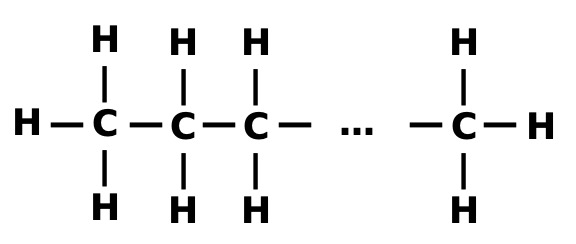
Energy in fossil fuels: fossil fuel molecules are long chains of hydrocarbons:
If we make abstraction of the hydrogen atom at each end, we are mainly burning the CH2 links, independent of the length of the molecule. This gives then about 42GJ of energy per kg, and it is independent of which fuel: diesel, light benzine, etc. The notable exceptions are those fuels whose molecules are very short, whereby the ending hydrogen atoms do have influence: methane and alcohol.
Power: If you have trouble with the unit “Watt”: just say “Joules-per-second” instead! Watt is a unit of flow of energy.
1A out of a 240V socket is 1×240=240J/s=240W. 10A sockets are good enough for 2400W
Cooking hob: 2000W; Fridge when running: 150W; Human being at rest: ≈50W
Units
Use the correct way of measuring, i.e. the correct unit
Light bulbs: not W but lumen, though in the days of incandescent bulbs only, the light output was proportional to the power, and this has become ingrained. Sigh.
With LEDs it is about 100 lumen per W.
For same suction power: Dyson vacuum cleaner: 1000W Electrolux vacuum cleaner: 500W. Vacuum cleaner efficiency should be measured in Pascal/W (how much under-pressure they produce for power used). I let you guess which of he above two actually “sucks” better.
Understanding
If a person cannot explain the difference between a kWh and a kW, then don't trust them with anything…
(1kW = 1000 Joules per second, 1kWh is 1000 Joules per second consumed for one hour = 3'600'000 Joules)
Orders of Magnitude
18 exa
15 peta
12 tera
9 giga
6 mega
3 kilo
0
−3 milli
−6 micro
−9 nano
−12 pico
−15 femto
Physiology
Some units are “absolute”, others are dependent on the way the human body senses the quantity:
radioactivity: gray; but damage to human tissue: sievert (rem)
sound pressure: Pascal; but humans perceive phon
Metric Units
The metric system of units was created to provide a coherent system of measuring qunatities. The originators made two claims:
units should be reproducible by anyone, i.e. they should be derived from “universal” physical phenomena, not the human body.
there should be no other conversion factors than powers of 10.
The chosen ones were:
for length: the circumference of the Earth
for time: the length of the day (sidereal)
for mass: the density of pure water
One criticism was that the phenomena are not sufficiently well-defined for very high precision. For example: the circumference of the Earth is not the same when measured along a meridian circle or along the equator, because of the ellipsoidal form of the planet (which was not confirmed at the time).
My own criticism is that using base 10 means it is not possible to divide a quantity by 3 easily: 10 has factors 2 and 5, but not 3. You don't normally cut a cake into 5, but you do often cut it into 6. Choosing base 12 would have been much better. The Imperial system does have factors 3 in many places: 3 feet to a yard, 12 inches to a foot, a dozen dozen to a gross (144). Base 12 would however have meant to introduce two new digits, and to re-train everyone to new tables of multiplication. There are still people in favour of a “dozenal” system instead of our classic decimal system. (UK dozenal Society — US dozenal Society)
The metric system did not succeed in its imposing its unit of time: the metric second was defined as the 100th part of a metric minute, itself the 100th part of a metric hour, which was a 10th of a day. Ultimately thetime unit remained the classical second: 1/60 of 1/60 of 1/24 of a day.
The metre is a 1000th part of 1km = 1/10'000 of quadrant meridian → Earth circumference = 40'000km. 1km = 1 minute of a grade, 100 grades in a right angle, 100 minutes in a grade. (this is in fact the metric equivalent of nautical mile from the Imperial system; see amusing calculation at end of this chapter))
The kilogram was defined as the mass (not weight!) of a cube of 10cm×10cm×10cm of pure water.
The second remained the classical second.
But then electricity came in, and a new unit was needed: the ampère. This was defined as the current that induces a force of 2×10⁻⁷ Newton over one metre between two conductors spaced 1 metre apart.
Paper sizes
It looks like the standard paper size of A4 is not metric. Two considerations were at the basis of the A4 size:
the size A0 should be 1m2 in area
the ratio between the long and short sides should be such that cutting in two leaves the ratio the same
There is only one ratio that satisfies this: √2. This is 1.4142, and smaller than the golden ratio of 1.618. Thus the width and length of a sheet of size A0 must be 841mm × 1189mm in order to be 1m2 in area. Cutting this several times to A4 then gives 210mm×297mm: 16 pages A4 cover 1m2. Normal paper has a thickness that makes it weigh 80g per m2, and since that is the same area as 16 A4 sheets, an A4 sheet weights 5g.
There is no experimental evidence that the “Golden Ratio” is more pleasing to the human eye than any other ratio.
Non-Metric Units
A few familiar units are not metric, though they look like it.
Energy: 1kWh = 3'600'000 J. It would be better to use a megaJoule.
Energy: 1calorie = 4.186 J food: kCal, = 4kJ. Most food now shows kJ, with kCal additionally available.
Speed: 1km/h = 0.278m/s. Better would be metres per second: 1m/s = 3.6km/h, about normal walking speed. 10m/s = 36km/h; 20m/s=72km/h; 30m/s=108km/h
As mentioned above, the second is arguably not a metric unit, since it is 1/86'400 of a day instead of 1/100'000
Typography: pica, point (1/72 inch), Screens and printers: dpi (dots per inch), Precious stone weights: carat = 0.2g, …
Note that it is illegal in the EU to sell products in non-metric units, thus the size of computer screens should be expressed in cm not inches.
A mAh is NOT a measure of energy, but a measure of electric charge. To get a measure of energy you have to know the voltage at which the current is delivered. For batteries that happens to be about 1.5V, as determined by the physics of the workings of the battery. A battery pack with a USB outlet provides 5V. If it is marked as 10'000mAh then it holds 5V×10Ah = 50VAh = 50Wh = 50x3600 J = 180'000 J. Remember 1kWh is 3'600'000 J.
Finally the amusing calculation. You should be able to do this without a calculator: make a circle with a few friends, holding hands, and spacing yourselves about a metre apart. If you did this with the entire population of the Earth, somewhere along the equator, would you be able to go all the way around the planet? We know the population is about 8 billion. The circumference of the Earth is, by definition, 40'000km, or 40'000'000 metres. Thus, 40 million people standing a metre apart, would go around indeed, and since we have 8'000 million, we could go around 8'000/40=200 times!
Chemistry
Preparing for my chemistry exam, I learned part of the table of elements by heart. Only the first four rows:
H
He
Li
Be
B
C
N
O
F
Ne
Na
Mg
Al
Si
P
S
Cl
Ar
K
Ca
Sc
Ti
V
Cr
Mn
Fe
Co
Ni
Cu
Zn
Ga
Ge
As
Se
Br
Kr
Rb
Sr
Y
Zr
Nb
Mo
Tc
Ru
Rh
Pd
Ag
Cd
In
Sn
Sb
Te
I
Xe
W
Pt
Au
Hg
Pb
In the table above, two more rows have been added, to highlight some elements with useful properties.
Chromium is a hard and shiny metal, just below it is Molybdenum which is used in hard alloys of iron, and below that is Wolfram (tungsten) which is very hard, used in machine tools.
Copper is a nice colour metal that conducts electricity very well, while being fairly cheap. Below it is silver, a nicer shine, and conducting electricity even better (though not cheap), and below that is gold, which has a very much appreciated shine, does not corrode, and is the best conductor for electricity, though also the most expensive.
Maths
You should know at least the following values:
π = 3.1415926535… mnemonic: the number of letters in the phrase: English: “See, I have a rhyme assisting my feeble brain” French: “que j'aime à faire connaitre un nombre utile aux sages”
√2 = 1.414
log10(2) = 0.30103
e = 2.718281828
32+42 = 52 ← this Pythagorean triple you should know! Such triples are defined to use whole numbers. Other ones can be found in the Wikipedia.
Funny note: there are some Lego sets where right-angled triangles appear. Since Lego parts fit into a grid, i.e. you cannot assemble bricks at any arbitrary distance, such triangles must be Pythagorean triples. Most Lego set triples are indeed correct, and cleverly designed. But at least one is not: the grand Ferris Wheel (set #10247) contains one with a small error in the light blue supports of the main axle.
Statistics and Probability
Remember these:
distinguish mean from median
take into account dispersion σ
normal distribution does not always apply
If possible, consider or list all possibilities (two-boys problem)
Careful with phrasing of the problem!
Often it is easier to find the probability of a phenomenon P by calculating the probability of not-P (number plates)
All possibilities
Consider the “two-boys” problem. The following question is asked: ”A person says they have two children, one of which is a boy. What is the probability that the other child is also a boy?”
To simplify the problem, let us first assume these assumptions:
there are no twins, children are born one after the other
the gender of a child is either boy or girl
the probability of a child being a boy is 50%, for a girl it is also 50% (this is not really true: there are about 104 boys born for 100 girls)
the gender of the second child is not influenced by that of the first child
The answer to the question is: 1/3.
To understand this we list all possibilities: in the case of two children, and under the above assumptions, there are four equally likely configurations: boy followed by boy, girl followed by girl, boy followed by girl, girl followed by boy. Note that there are indeed two configurations with mixed gender. There are also two configurations with identical gender:
The person did not specify whether the boy child was their first or second (careful with phrasing of the problem!). All we know is that it is a boy, therefore all we can rule out is the case girl-girl. This leaves us three equally likely cases, only one of which has two boys. A probability of 1/3. This outcome is in conflict with the instinctive feeling that the probability of the other child being a boy is 1/2.
It is perhaps easier to accept this somewhat counter-intuitive result by considering the other possible statements the person could give:
“I have two children.”: the probability of them both being boys is then 1/4.
“I have two children, one of them is a boy.”: we can only eliminate the girl-girl case, so it is 1/3.
“I have two children, the first one is a boy.”: now the second one has a probability of 50% to be a boy, and so the probability of 2 boys is 1/2
“I have two children, both are boys.”: now it is obviously 1/1.
The more information the person gives us, the more we can eliminate and the higher the probability.
There is a similar counter-intuitive problem: a game host shows you three closed doors and tells you there is a prize for you behind one of the doors, but nothing behind the other two:
(in the above top-view figure, the prize is behind the first door)
You are allowed to choose a door, after which the host opens one of the remaining two doors, showing an empty space. There are now two closed doors left, and you are allowed to change your choice to the other door than the one you chose first. Should you change doors?
The answer is yes, and it is also justified because opening a door by the host does give you more information. It goes like this:
At first you have no information, so you choose at random and have a probability of 1/3 to choose the right door. But the show host interferes, there are three possibilities:
you chose door 1; the show host now has the choice of opening door 2 or door 3; if you change your choice you lose.
you chose door 2; the show host cannot open door 1, they are forced to open door 3; if you change your choice (to door 1) you win.
you chose door 3; the show host again is forced to open the remaining empty door, i.e. door 2; if you change your choice (to door 1) you win.
Therefore, if you change doors, in 2 cases out of 3, you will win. But if you do not change doors, then you win only in 1 case out of 3. And again it is the extra information that helps: the knowledge that in two cases of 3 the show host's hand is forced.
Probability of not-P
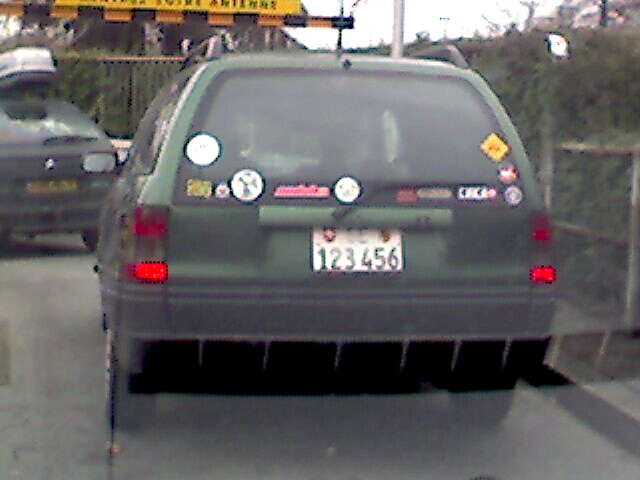
A long time ago I saw this car entering an underground parking in Geneva:
Of course I could not resist taking a photo. But then it occurred to me that number plates with one or more digits repeated are quite common, and this one definitely was not among them.
How many plates have at least one digit repeated?
Let us first assume that all plates have six digits (as they do in Geneva), secondly assume that all digits are used, i.e. there is a car with plate 000000 (this is of course not the case), finally assume that the plates go up to 999999 (and that too is of course not so in reality). So we have one million number plates, from 000000 to 999999. How many have repeated digits?
Let us call this number R (for “Repeated”). The probability P to encounter at random a number plate with at least one repeated digit is then R/1'000'000. But what is R?
Plates with repeated digits have numbers like 123455, but also 122455, in the latter there are two digits repeated. And 212545 also has two digits repeated.
If you try to find R by trying to list them all, you will run into a difficult computation.
But computing 1-P is fairly easy: find the number of plates with no repeated digits, i.e. with all digits different.
Choose the first digit: you have a choice of one out of 10. But for the second digit you have only a choice of one out of 9, because the second digit must be different from the one you chose first. The third digit must be different from the first two, leaving you a choice of one out of 8.
The number of plates with no repeated digits is then 10×9×8×7×6×5 (there are only 6 digits), which is 151'200.
Hence 1−P = 1− 151'200/1'000'000 = 0.8488. Almost 85% of plates have a repeated digit!
As an aside:
single digit numbers of course have no repeated digits, the probability of choosing a single digit number with all digits different is 100%.
double digit numbers go from 00 to 99, a hundred numbers, and 00, 11, 22, … , 99 do have repeated digits, there are 10 such numbers, therefore there are 90% numbers with different digits.
this goes on down as you add digits; it comes to 15.1% for 6 digits.
when you reach 11 digits the probability must be 0: it is impossible to write a number of 11 digits without repeating at least one digit.
Be careful with interpreting graphs
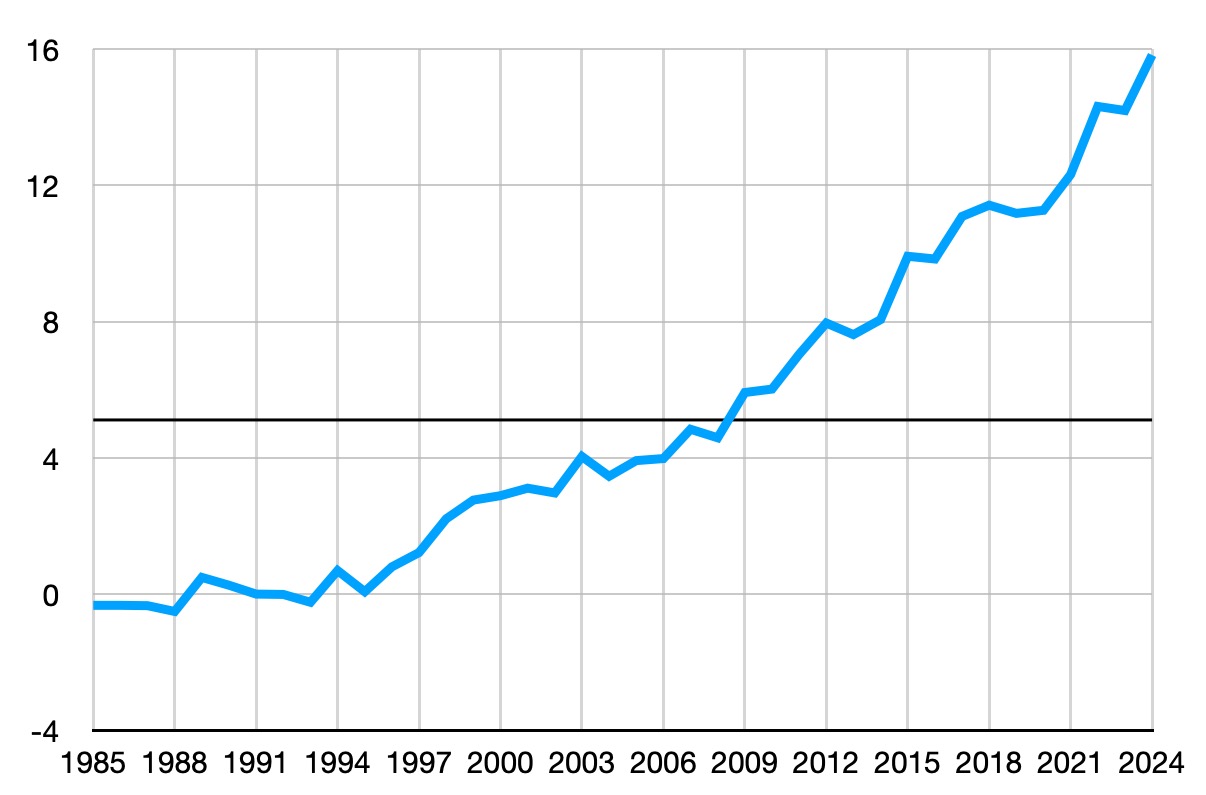
Not long ago I saw this graph:
It shows the evolution of some temperature over the years (line in blue), and was meant to show an effect of global warming. But unfortunately the well-meaning author had also put a horizontal black line at the average of their numbers. One observer exclaimed: “Look, the average has not moved! For 40 years the average has not moved! Global warming is a hoax!”. Sure.
Astronomy and Geophysics
The Universe
speed of light: 300'000km/s (7 times around the planet in a second) (in cables 150'000km/s)
approximate number of particles in the universe: 1080
time since Big Bang: 13.8 billion years
Earth:
acceleration of gravity on Earth: g = 9.81 m/s2 ≈ 10m/s2
atmosphere: 78% N2 + 21% O2 + 1%Ar
speed of sound: 343m/s ≈ three seconds per km (allows you to estimate the distance of the storm by counting from seeing the lightning to hearing the thunder)
distance to Moon 384'000km (a bit more than a light-second)
The apparent diameter of the disc of the Sun (or Moon) in the sky is about half a degree. There are 360 degrees in a full circle, or 720 Sun discs, which the Sun moves through in 24 hours or 24×60=1440 minutes. It therefore takes the Sun 24×60/720=2 minutes to move an entire apparent diameter. The apparent diameter is also about the apparent width of your thumb when viewed at arm's length.
Know the layout of our planet Earth: continents, countries, mountain ranges, deserts, lakes, … Get a globe: you cannot grasp positions and sizes fully using a flat map. Globes are not expensive.
But let's just do an exercise in manipulating large numbers.
In Larry Niven's Sci-Fi novel “Ringworld” there is a civilisation that constructed a habitable ribbon around their sun. The question posed here is: how much material would it take to make such a ring around our sun, if the cross section of the ring is just 1m2?
This is a very thin ring, but it goes all along the orbit of the Earth around the sun.
The orbit is 150 million km in radius, or 300 million km in diameter. Therefore its circumference is π×300 million km. We know π is somewhat greater than 3, so π×300 is going to be more than 900, say close to 1000. Our ring is then 1000 million km long, or 1000'000'000km or 1'000'000'000'000 metres, 1Tm (one tera metre). It has a section of 1m2. If we make it from cubes of 1m3, we will need one cube per metre along the orbit, or 1Tm3. That is 1'000'000'000'000m3.
Now, we can picture a cube of 1km by 1km by 1km: 1km3. Since there are 1000 metres in a km, such a cube contains 1'000'000'000m3. Our ring then needs 1'000km3 of material.
That is a cube of 10km×10km×10km. That we can still picture. Mount Everest is roughly 8km high, and can be thought of as a pyramid with a base of 8km×8km. Then it has a volume of 8×8×8/3km3 (the division by 3 is because of the pyramidal shape instead of a cube). A volume of 512/3=170km3, but we need 1'000km3, and remembering the table of inverses, 1'000/170 is roughly 6.
So we need six times the material in Mount Everest. That would make a rather big hole in the Himalayas, but would hardly be noticeable on the scale of the planet!
If we used up all the mass of the Earth, to make many more rings, putting them side by side, to make a wider ribbon (but still only 1m thick), how wide could we make the ribbon? We would get 1 extra metre of width for each extra 1'000km3 of Earth material we would use.
The Earth is roughly 1.082×10¹²km3 in volume. Roughly 1'000'000'000'000km3. We get an extre metre of width for each 1'000km3, so we have a ribbon of 1'000'000'000 metres wide, or 1 million km wide! And that is using only the material in the Earth.
Biology
Know the layout of the human body; where your organs are, your bones.
Know something about evolution (not just animals but also plants).
Understand how evolution works. It is quite negative: it's not so much survival of the fittest as death of the unfit.
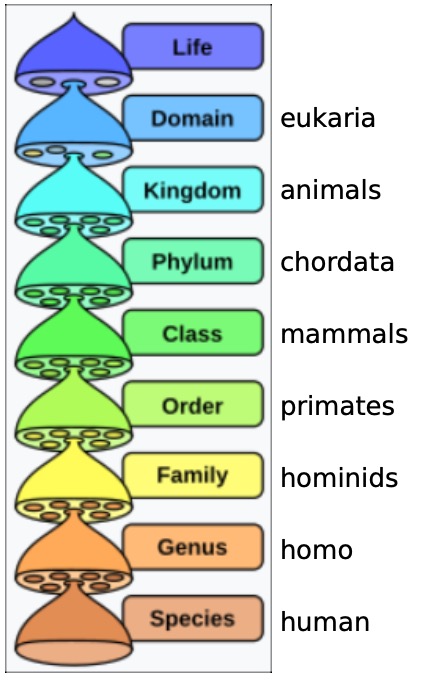
Know at least that there is a classification of living things, even if you do not know the hierarchy:
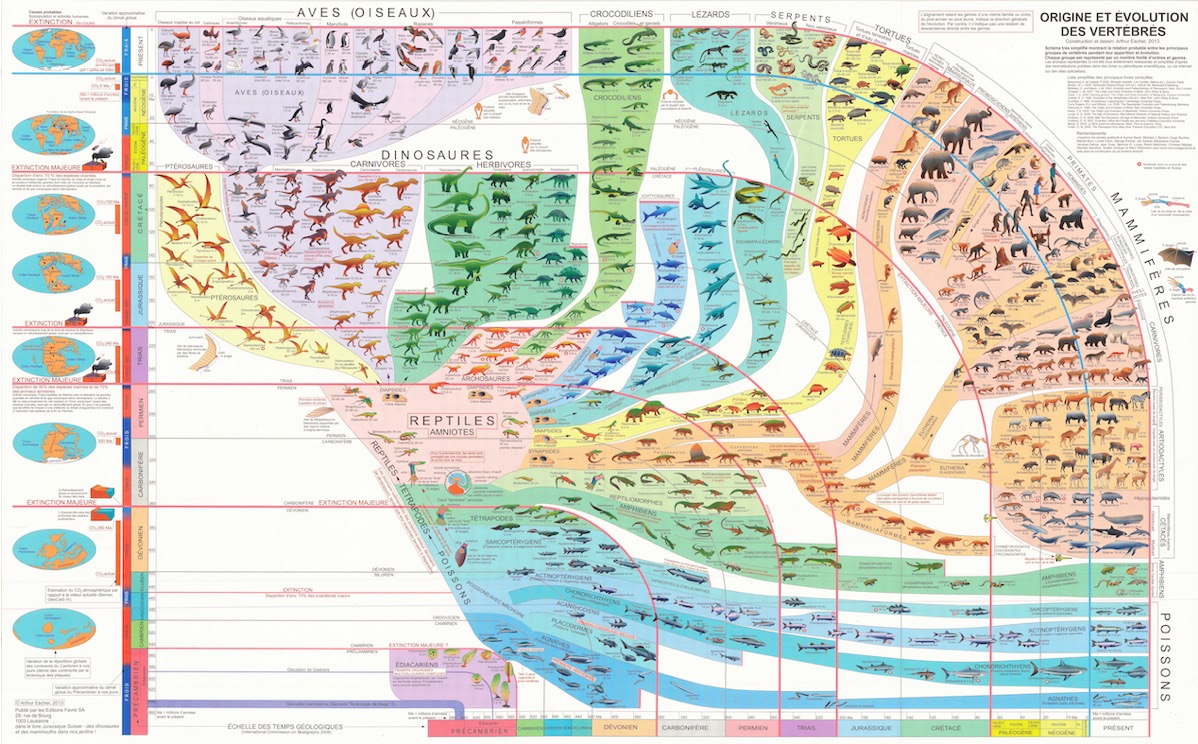
There is a brilliant book on the evolution of vertebrates:
It is the clearest and most complete chart I have ever seen on any topic. Apart from the animals it shows the temperature of the atmosphere for each era, the CO2 content, the location of the continents and the major extinction events.
People are mostly interested in the evolution of vertebrates: dinosaurs inspire more than jellyfish. But there are other living things: plants are mostly forgotten. There is an episode in Star Trek where they land on a planet with multi-coloured plants everywhere, but no animal life, so they conclude “no life forms detected.”
List of values
(some repeated from above)
LED lights: ~100 lumen/W I have living room lights that use 28W and produce 3000lumen. Note that many manufacturers still put “W equivalent” figures on their light bulb packages. This is confusing and misleading: the light coming from a classic, incandescent light bulb of 60W is about 600 lumen, i.e. approximately 10 lumen per watt instead of 100. But the impression of quantity of light you get is very much dependent also on the colour of the light (from yellowish to blueish white) and the shape of the light source (bulb, strip, flat panel, … ) LED lights are not very much more efficient than fluorescent lights, their main advantage is in the shapes they can take and the long life. The life span of a LED source though is limited not so much by the LED technology as by that of the electronics needed to convert the 240V alternating current into the low voltage direct current the LED needs. This conversion electronics is inside the bulb; the rare materials in it should be recycled.
seconds in a day: 86'400 (mnemonic: decreasing order 8,6,4, descending by 2)
8'760 hours in a year (menmonic: 8-7-6, descending by 1)
365.25 days in a year
Solar constant: energy emitted by the sun through 1m2, at the distance of the Earth: 1360W
Solar panel energy conversion 20 to 25 % (at time of writing, 2026)
Atmospheric pressure: about same as in a column of 10m of water. Also 1kg-force on 1cm2
1 bar of pressure equals 10m of water (approximately). To get water to the faucets at the top of a 40m high building you need at least 4bars at the bottom. A bar is very close to atmospheric pressure at sea level, where it is 1.013bars. The bar is defined as 100'000Pascals (100'000N/m2). In diving you get 1 bar extra pressure per 10m you go down.
1.2kg/m3 density of air at standard temperature and pressure
Power of a human being: a farm labourer needs 2500kCal per day; or 2500x4.2 = 10'500 MJ, say a normal person would use 8'640MJ, then dividing that by 86'400 seconds in a day, gives 100W. It is somewhere between 60W and 120W.
Medium sized car on a flat road at reasonable speed: 40kW.
40'000km circumference of the Earth (by definition)
394'000km to the Moon
154 million km to the Sun
8 minutes for light to travel from the Sun to us
300'000km/s speed of light in a vacuum; 150'000km/s speed in a cable.
1.2kg/m3 density of air at standard temperature and pressure
4ºC temperature at which water is densest
Nearly all household liquids are 1kg/litre. Oil is more like 0.75.
−273ºC absolute zero
25.4mm in an inch (by the modern definition of the inch)
1.609 km to the mile
1.852 km to the nautical mile; a nautical mile is one minute of arc on the Earth's surface; a km is one minute of a grade (100 grades in a right angle, 100 grade-minutes in a grade)
440Hz the standard middle note of the piano
16-20'000Hz the limits of the human ear (when your age, not my age)
pH: 0=acid 7=neutral 14=alkaline or basic
Coffee is mildly acidic.
2.4GHz = frequency of microwave & older WiFi
21cm wavelength of hydrogen emission, therefore also thought ot be the best wavelength to listen on or to transmit on for extraterrestrial comms.
6x10²³ Avogadro's number (the 23 is the important bit)
343 m/second speed of sound at standard air pressure; or about 3 seconds to cover 1km, therefore counting the seconds between seeing a lightning and hearing the thunder, will tell you how far away the lighting struck: divide seconds by 3.
About 4'000 characters in a reasonable font size on an A4 page.
2.5m the legal height of a room; 3.0m the height of a “floor” in a building (the thickness of a floor being approx. 50cm). This lets you quickly estimate the height of a building by counting the number of floors.
Law of Titius—Bode (not really a law, but a “reasonable fit”) for the distances of the planets from the sun:
(a) write the powers of 2, but start with 0:
0 1 2 4 8 16 32 64 …
(b) multiply by 3:
0 3 6 12 24 48 96 192 …
(c) add 4:
4 7 10 16 28 52 100 …
To remember this: the strength of the operator goes down (power-multiplication-addition) while the number used goes up (2-3-4).
Now divide by 10 to get astronomical units (distance Sun-Earth)
0.4 0.7 1 1.6 2.8 5.2 …
and that gives the distances from the Sun of Mercury, Venus, Earth (=1 of course), Mars, the asteroid belt (2.8) and Jupiter. Useful when going into space to find mysterious monoliths.
Energy in a standard, good quality AA battery. It gives 1.5V. But I don't know the energy. And mAh is NOT an energy unless one knows the voltage.
111km is a degree of latitude.
A MAC address has 12 hexadecimal digits. A hexadecimal digit encodes 4 bits. Thus a MAC address is a 4×12=48 bit number. That gives 2^48 possible MAC addresses. How much is that in decimal?
Well, 10^0.30103 = 2 (0.30103 being the logarithm of 2 in base 10, a number surely everyone knows…)
Or a 14 digit number. 1G=10^9, 1T=10^12. A hundred tera = 10^14. Or 10^14/10^10=10'000 per inhabitant of the planet. (actually 12'000, per the table of inverses, since we are not 10 but only 8 billion people)
Water
(the only thing that might conceivably make me believe in a supernatural power)
water is a universal solvent
water is neutral (not acid nor base)
water expands when freezing
ice melts when compressed (skating)
water is most dense at 4ºC (protecting the fish at the bottom of the pond in freezing cold)
ice sublimates (drying clothes in freezing weather)
snow reflects light (in dark winters)
moist air rises
ice needs 335 J per gram to melt (80cal); a very high amount, keeping ice for a long time
water needs 4.186 J per ºC to heat up (1calorie, definition of the calorie)
water needs 2'260 J per gram to vaporise! (540cal, steam energy); a very high amount, allows you to boil food without running out of water, or to get very warm with steam-condensing radiators
Apart from wind, solar and hydro, all the electric energy you use to power your very high-tech devices is generated by steam engines: they are steam turbines, for which the steam is heated by fossil fuels or nuclear power.
General
Know the layout of the planet: continents, countries, mountain ranges, deserts, lakes, … (get a globe)!
Know long history & interaction of populations (read “Guns, Germs & Steel” or “Sapiens”)
Know systems of government & management. (Machiavelli: “The Prince”)
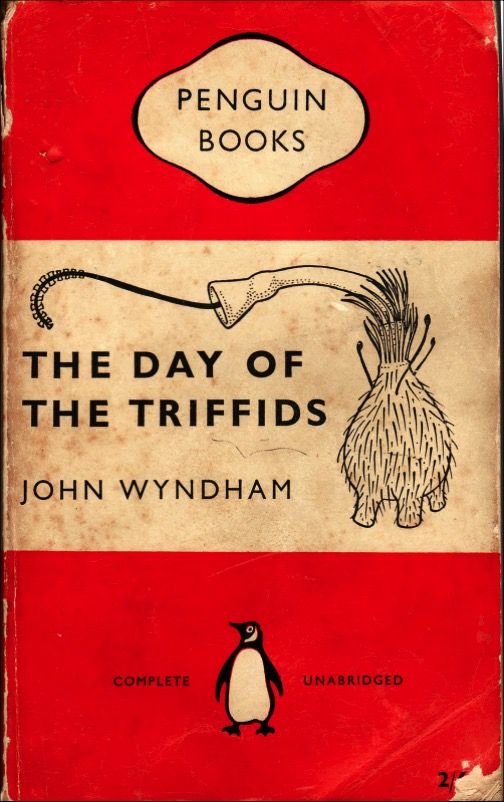
A collapse story, relevant to today's planetary situation: The Day of the Triffids John Wyndham
(this book is no longer in print. If you want to read it, you can get second-hand copies, or you can contact me) If you do read it, I would be interested to hear what you would have done diferently had you been in the same situation.